
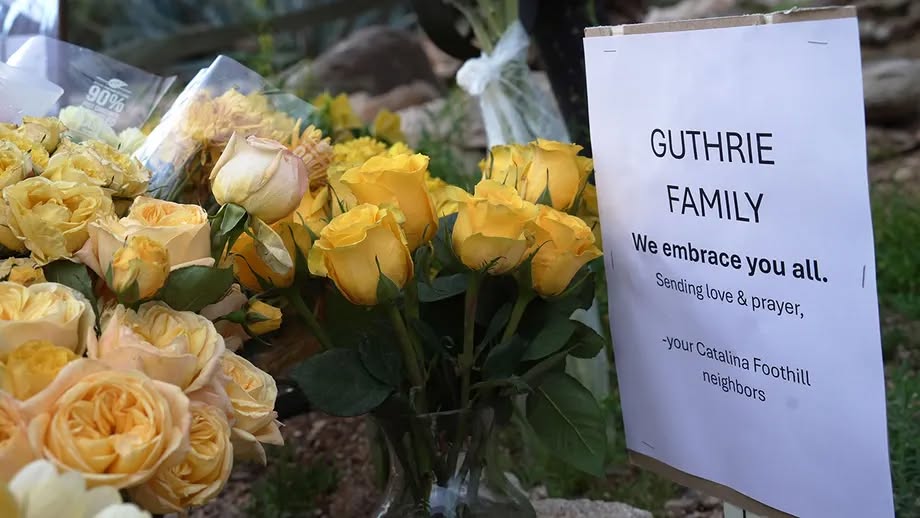
TUCSON, Ariz. — The sprawling, multi-agency investigation into the disappearance of 84-year-old Nancy Guthrie has officially entered its third agonizing week, marked by a frustrating forensic roadblock and a groundbreaking pivot to cutting-edge technology.
As the search for the mother of NBC Today show co-anchor Savannah Guthrie continues to grip the nation, authorities confirmed on Tuesday that the highly anticipated DNA sample extracted from a glove found near the crime scene failed to produce a match in the FBI’s national database. This setback has forced investigators to rapidly shift their strategy, deploying Investigative Genetic Genealogy (IGG) to hunt down the suspect’s family tree, while simultaneously utilizing military-grade “signal sniffers” in a desperate, high-tech bid to locate Guthrie’s Bluetooth-enabled pacemaker in the vast Arizona desert.
The Pima County Sheriff’s Department, working in tandem with hundreds of federal agents, continues to chase down more than 13,000 civilian tips. However, the lack of a traditional suspect profile has turned the case into a grueling digital and forensic marathon. Here is an extensive, in-depth breakdown of the latest developments, the technological warfare being waged by law enforcement, and the ongoing fight to bring Nancy Guthrie home.
The Forensic Setback: CODIS Yields No Hits
For days, the law enforcement community and the Guthrie family held their collective breath, waiting on the results of a crucial piece of physical evidence.
During an extensive grid search of the rugged terrain surrounding Guthrie’s Catalina Foothills home, the FBI’s Evidence Response Team discovered a black neoprene glove discarded approximately two miles from the residence. Visually, the glove appeared to be a perfect match to the specialized gear worn by the masked intruder captured on Guthrie’s doorbell camera at 1:47 a.m. on the night of her disappearance.
Forensic technicians successfully extracted a male DNA profile from the interior of the glove—a massive triumph that gave investigators hope for a swift resolution. That DNA profile was immediately uploaded and run through the Combined DNA Index System (CODIS), the FBI’s massive national storehouse containing the genetic profiles of millions of convicted offenders and arrestees.
On Tuesday, Pima County Sheriff Chris Nanos delivered the sobering news: the search came up completely empty. “We’re hopeful that we’re always getting closer, but the news now, I think, is we had heard this morning that, of course, the DNA on the glove that was found two miles away was submitted for CODIS. And I just heard that CODIS had no hits,” Nanos stated during a press briefing.
Furthermore, Nanos confirmed that the DNA pulled from the discarded glove did not match the unknown DNA profile that investigators had previously swabbed from the interior of Guthrie’s home.
The negative CODIS result is a double-edged sword. On one hand, it is a significant setback that delays an immediate arrest. On the other hand, it provides a crucial piece of criminal profiling: the perpetrator is likely not a known, violent felon with a prior record in the federal system. He is a ghost to the traditional criminal justice database.
The Pivot: Investigative Genetic Genealogy (IGG)
With the traditional avenues exhausted, the FBI is refusing to let the trail go cold. Authorities have officially announced their intention to utilize Investigative Genetic Genealogy (IGG) to unmask the suspect.
This is the exact same revolutionary forensic technique used to identify Joseph James DeAngelo (the notorious Golden State Killer) and Bryan Kohberger (the suspect in the Idaho college student murders). The process bypasses the criminal databases entirely and looks toward the commercial ancestry market.
How the IGG Process Works:
-
The Upload: Investigators take the unknown male DNA profile from the glove and upload the genetic sequence to massive, open-source commercial genealogy databases. Sites like GEDmatch have specific opt-in policies that allow law enforcement to search their records for violent felony suspects.
-
Finding Relatives: The system searches for partial matches—distant relatives of the suspect, such as third, fourth, or fifth cousins who voluntarily took a DNA test to explore their family tree.
-
Building the Tree: Once a distant relative is identified, highly specialized FBI genealogists begin building massive family trees backward to find a common ancestor (often living in the 1800s or early 1900s).
-
Tracing Forward: They then trace the branches of that family tree forward to the present day. Through a process of elimination—filtering the descendants by age, gender, and geographic location (specifically, men living in or visiting Tucson in February 2026)—investigators can narrow a list of thousands of distant cousins down to a single, highly probable suspect.
While IGG is incredibly powerful, it is not instantaneous. Experts warn that advanced DNA testing and the subsequent genealogical mapping can take weeks, or even months, to process depending on the quality of the sample and the complexity of the family tree.
The Retail Dragnet: Tracking the Ozark Trail Backpack
While scientists work in the laboratory, field agents are executing a massive, meticulous retail dragnet across southern Arizona.
The FBI has released a highly detailed physical description of the suspect, derived from the digitally enhanced doorbell camera footage. The individual is described as a male standing between 5 feet 9 inches and 5 feet 10 inches tall, with an average build.
Crucially, the footage captured the suspect wearing very specific, identifiable gear. He was clad in dark clothing, black neoprene gloves, an oddly placed firearm holster, and a distinctive black, 25-liter “Ozark Trail Hiker Pack” backpack.
Ozark Trail is a private-label brand sold almost exclusively at Walmart. Armed with this information, the FBI has partnered with corporate security at Walmart and other local sporting goods retailers. Agents are systematically scrubbing credit card receipts, self-checkout surveillance footage, and loyalty program data from stores across the Tucson metropolitan area. They are compiling lists of every individual who recently purchased that exact backpack, matching it with purchases of the specific gun holster and the dark knit jacket the suspect wore.
An Arizona gun store owner confirmed to news outlets that an FBI agent recently visited his establishment, asking him to review recent firearm and holster purchases tied to a list of nearly two dozen individuals. This targeted, commercial tracking aims to catch the suspect in the mundane act of preparing for the crime.
High-Tech Warfare: “Signal Sniffers” in the Sonoran Desert
The most agonizing aspect of Nancy Guthrie’s disappearance is the critical state of her health. At 84 years old, she suffers from cardiac issues, utilizes a pacemaker, and requires daily, life-sustaining medications that were left behind at her home. Sheriff Nanos has repeatedly warned that the situation could be fatal if she does not receive her medical care, stating plainly, “The clock is literally ticking.”
In a desperate, unprecedented bid to locate her, federal authorities have deployed highly specialized electronic tracking technology into the Sonoran Desert.
Investigators are utilizing “signal sniffers”—advanced radio frequency (RF) detectors typically used in military operations or maritime search and rescue. Guthrie’s pacemaker is reportedly equipped with Bluetooth functionality, a common feature in modern medical devices that allows doctors to remotely monitor a patient’s heart rhythm via an app or a bedside transmitter.
Federal agents, utilizing drones and low-flying helicopters equipped with these signal sniffers, are sweeping the vast, rugged terrain within the two-hour driving radius of Tucson. They are literally listening to the desert, hoping to detect the faint, electronic ping emitting from the 84-year-old’s heart monitor. It is a haunting, highly innovative strategy that highlights the extraordinary resources being poured into the rescue effort.
The Extortion Threat: A Fourth Ransom Note
As the physical search intensifies, the digital landscape has become a minefield of extortion and psychological torment for the Guthrie family.
The case has attracted global attention, and with it, opportunistic scammers looking to exploit a family’s desperation. Over the past three weeks, multiple purported ransom notes have been sent to local Tucson television stations and celebrity news outlets like TMZ.
This week, a fourth ransom note was delivered to TMZ. According to the outlet’s founder, Harvey Levin, the sender claimed to be an “intermediary” who knows the true identity of the kidnapper. The note demanded a confidential payment—reportedly matching the FBI’s $100,000 reward, payable in a specific cryptocurrency other than Bitcoin—in exchange for revealing the information. The sender alleged they witnessed Nancy Guthrie south of the border five days ago but refused to provide any actionable proof without upfront payment.
Levin sent a strong, public message to the extortionist on social media: “If you’re the individual claiming you know who the kidnapper is—prove it. Send us the info. We’ll forward it to the FBI and create a record tying it to you… So this is a way for you to get that money if this really is legitimate.”
The FBI is treating these notes with extreme skepticism. Authorities have warned that anyone attempting to scam the Guthrie family with fake ransom demands is committing federal wire fraud and extortion. To date, the family has received no verifiable “proof of life,” despite Savannah Guthrie’s emotional, public pleas indicating a willingness to pay for her mother’s safe return.
Dispelling the Rumors: The Family and the Gem Show
The intense media scrutiny surrounding the case has generated a whirlwind of armchair sleuthing and bizarre internet rumors that law enforcement is actively trying to suppress.
1. The Family is Cleared: In the initial days of the probe, social media commentators wildly pointed fingers at Savannah Guthrie’s sister, Annie, and her husband, Tommaso Cioni, simply because they hosted Nancy for dinner hours before she vanished. Pima County Sheriff Chris Nanos has unequivocally and publicly cleared the entire Guthrie family of any involvement. “The family has been nothing but cooperative and gracious and are victims in this case,” Nanos stated, decrying the online rumors as cruel and baseless.
2. The Gem Show Distraction: Recently, a new conspiracy theory gained traction online when a valuable piece of native gold was stolen from the Tucson Gem and Mineral Show by an individual wearing a mask. Internet sleuths immediately attempted to link the jewel thief to the masked intruder at the Guthrie home, theorizing that the kidnapper was an international jewel thief who targeted the wrong house.
The FBI and local police have firmly shut down this theory. There is absolutely no official confirmation or evidence tying the targeted abduction of an 84-year-old woman to a retail theft at a local gem exhibition. Law enforcement continues to urge the public to avoid spreading unverified rumors that distract from legitimate investigative efforts.
A National Response and a $100,000 Reward
The disappearance of Nancy Guthrie is no longer just a local Tucson tragedy; it is a national crisis that has reached the highest levels of government.
President Donald Trump recently weighed in on the case publicly during an interview. Expressing his outrage over the abduction, the President stated that if Nancy Guthrie was killed, he would want the Justice Department to seek the death penalty for the perpetrators. He called for the abductors to face “very, very severe – the most severe” consequences for targeting a vulnerable, elderly citizen.
Meanwhile, the financial incentive to break the case has grown exponentially. The FBI officially doubled its reward to $100,000 for information leading to the location of Nancy Guthrie or the arrest and conviction of anyone involved in her disappearance. Additionally, an anonymous donor recently stepped forward, pledging another $100,000 to the fund, bringing the total potential payout to a staggering $200,000.
The Road Ahead: Searching for a Breakthrough
As day 19 draws to a close, the investigation remains a complex web of high-tech forensics, exhaustive grid searches, and digital dragnets.
The Pima County Sheriff’s Department has fielded more than 18,000 calls. Geofence warrants and cellular tower dumps are actively being analyzed to identify any anomalous mobile devices that pinged near the Guthrie home between 2:30 a.m. and 3:00 a.m. on February 1. Federal and local officers continue to go door-to-door, begging residents within a two-mile radius to hand over any security footage from the entire month of January.
“It’s exhausting, these ups and downs,” Sheriff Nanos admitted in a recent interview, reflecting the fatigue of a department working around the clock. “But… We’re going to find Nancy. We’re going to find this guy.”
For the Guthrie family, the nightmare continues. Savannah Guthrie and her siblings have paused their professional lives—with Savannah stepping away from her anchor duties—to focus entirely on bringing their mother home. They remain tethered to their phones, hoping the next call will bring the miracle they have been praying for.
Authorities continue to urge anyone with information, no matter how insignificant it may seem, to step forward. Have you noticed a coworker acting erratically? Did someone you know recently discard a black Ozark Trail backpack or a dark knit jacket? Did you see an unfamiliar vehicle in the Catalina Foothills during the early morning hours of February 1?
Anyone with information related to the case is urgently asked to contact the FBI at 1-800-CALL-FBI (1-800-225-5324) or submit a tip online at tips.fbi.gov. The investigation remains fiercely active, with law enforcement vowing to leave no stone—and no strand of DNA—unturned in their pursuit of justice.
Leave a Reply